
Introduction
Inside every healthy hive is a remarkable transformation process. What begins as raw flower pollen becomes something entirely different, something more stable, more digestible, and more usable for the colony.
This substance is known as bee bread.
Often overlooked compared to honey, bee bread plays a critical role in the survival and strength of the hive. It is the primary protein source for developing bees and a key component in colony health.
In this guide, we’ll explore what bee bread is, how it is made, and why it has become increasingly interesting to people exploring fermented foods, whole-hive nutrition, and traditional natural products.
What Is Bee Bread?
Bee bread, sometimes called perga, is fermented pollen stored inside the hive.
Unlike raw bee pollen, which is collected directly from flowers, bee bread has already undergone a natural transformation inside the honeycomb.
Bees combine pollen with nectar and enzymes, then pack it tightly into cells where it ferments over time. This process changes both its structure and composition.
The Hive’s Natural Fermentation Process
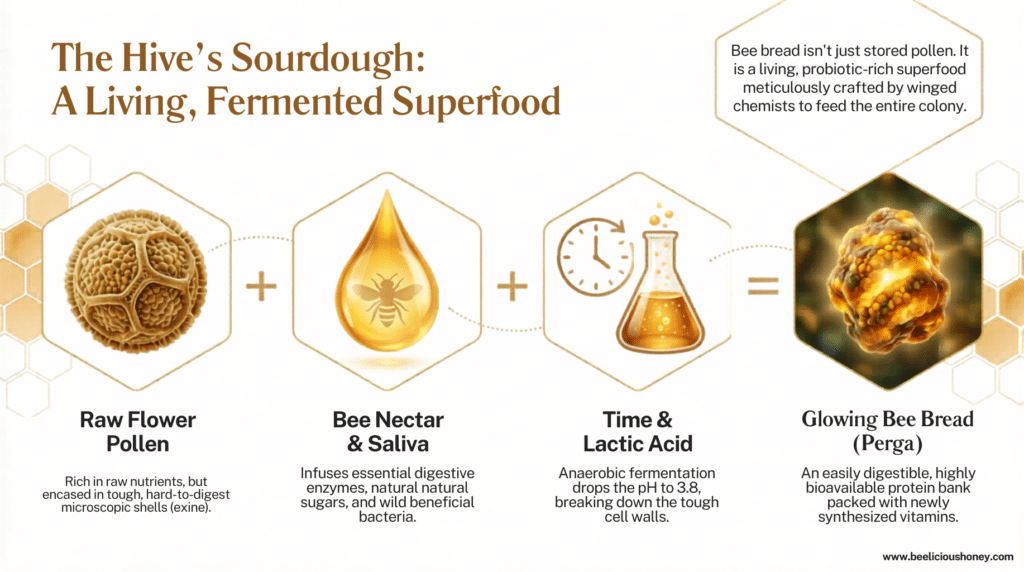
Step-by-step inside the hive:
- Pollen Collection
Worker bees gather pollen and carry it back to the hive. - Enzyme Infusion
The pollen is mixed with nectar and bee enzymes. - Packing the Cells
Bees compress the mixture into honeycomb cells, removing air. - Sealing the Surface
A thin layer of honey and wax seals the cell. - Natural Fermentation
Beneficial microbes convert sugars into organic acids, lowering the pH and preserving the contents.
This creates a stable, long-lasting food source for the colony.
Why Fermentation Changes Everything

Raw pollen has a tough outer shell called sporopollenin, which can limit how much of its contents are accessible.
Fermentation helps break down this outer layer.
What changes:
- The structure becomes softer
- Organic acids develop
- Microbial activity increases
- The material becomes more stable over time
This is one reason bee bread is considered fundamentally different from raw pollen.
Why the Hive Depends on Bee Bread
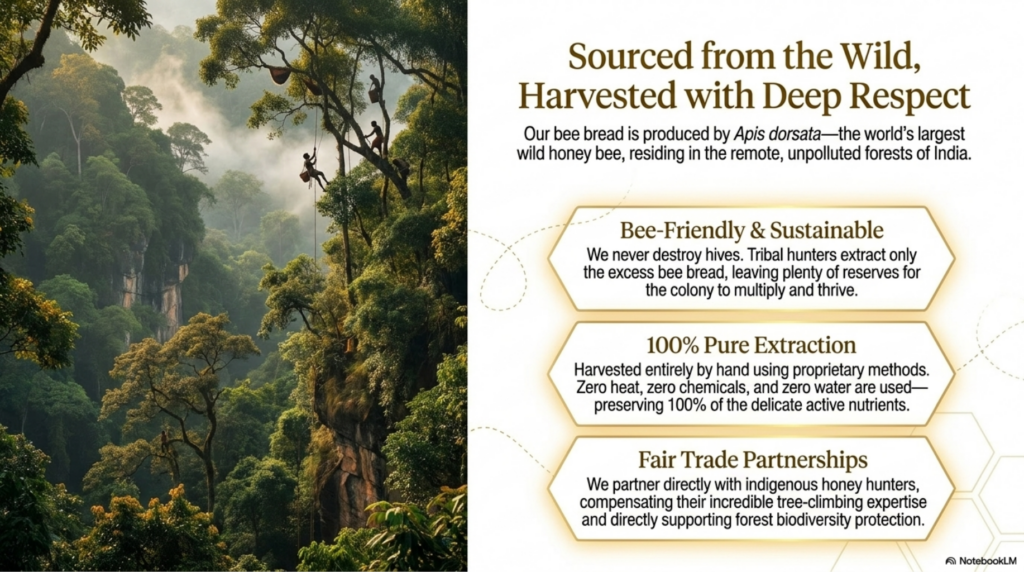
Bee bread is not just stored food. It is essential to the colony.
- It feeds developing larvae
- It supports nurse bees
- It provides protein and nutrients needed for growth
- It helps sustain the hive during times when fresh pollen is unavailable
Without it, the colony cannot thrive.
A Closer Look Inside the Comb
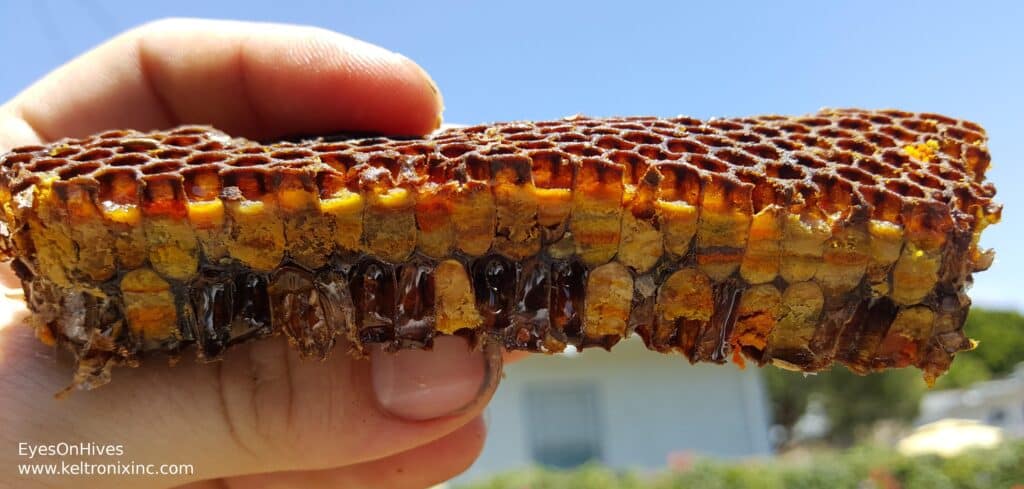
This cross-section shows the layered structure inside the hive:
- Fresh nectar
- Stored honey
- Packed pollen
- Darker, fermented bee bread
This visual helps tell the story better than words alone.
Bee Bread and Traditional Use
Bee bread has been used historically in various cultures as a traditional hive food.
Modern interest is growing because of:
- Its natural fermentation
- Its connection to whole-hive nutrition
- Its complexity compared to single-ingredient products
Recent scientific reviews have also taken a closer look at bee bread, exploring its composition, natural fermentation process, and the presence of diverse bioactive compounds. Source: [National Library of Medicine study on bee bread]
Rather than focusing on a single component, researchers often describe bee bread as a complex, naturally transformed substance that reflects both botanical diversity and microbial activity within the hive.
This growing interest helps explain why bee bread is being studied alongside other traditionally fermented foods.
Rather than focusing on isolated components, bee bread represents a complete, naturally transformed food created by the hive itself.
This is part of what makes it interesting to people today — not as a processed ingredient, but as a traditionally formed food shaped by fermentation, time, and the natural environment.
Why Humans Are Interested in Bee Bread
While bee bread is created for the hive, it has also drawn attention from people interested in traditional and naturally fermented foods.
Several characteristics make it unique:
- It is already transformed by fermentation
Unlike raw pollen, bee bread has undergone a natural process inside the hive that changes its structure and composition. - It represents a whole-hive food
Rather than a single isolated ingredient, bee bread reflects a combination of pollen, nectar, enzymes, and microbial activity. - It has a naturally complex flavor
Often described as tangy, slightly sour, and earthy, bee bread offers a very different experience from honey. - It connects to traditional food practices
Fermented foods have been valued across cultures for generations, and bee bread is one of nature’s most unique examples.
For many, the interest is not about a single benefit, but about experiencing a food that has been naturally transformed inside the hive.
A Simple Way to Experience Bee Bread
Because of its strong, tangy flavor, bee bread is often combined with other hive products.
One of the most balanced ways to enjoy it is in a blended mixture.
The Bee-Licious Hive Elixir
How People Typically Use Bee Bread
Because of its strong, tangy flavor and dense texture, bee bread is usually consumed in small amounts.
It is often:
- Taken on its own in small portions
- Paired with honey to balance the flavor
- Combined with other hive products for a more rounded taste experience
For many, the appeal is not just what it contains, but the fact that it is already naturally transformed inside the hive.
Ingredients:
- A small amount of bee bread
- A spoonful of Tualang honey
- A small portion of fresh royal jelly
How to prepare:
- Mix into a smooth blend
- Take in small amounts
- Can be eaten directly or added to warm (not hot) liquids
Why this combination works well:
- Honey provides natural sweetness and smooth texture
- Bee bread adds depth and complexity
- Royal jelly contributes a creamy, slightly tangy note
This creates a balanced, traditional-style blend using multiple hive components.
- Tualang honey product page
- Royal jelly product page
- Gut microbiome write up page
Final Thoughts
Bee bread is one of the least understood, yet most important, substances inside the hive.
It represents:
- Natural fermentation
- Long-term food storage
- A complete nutritional system created by bees
While honey may be the most recognized product of the hive, bee bread tells a deeper story about how bees transform and preserve what they collect from nature.
For those curious about exploring bee bread, starting with small amounts and pairing it with honey is often the easiest introduction.


