Last updated: Sept 2026
What is Tualang honey?
Quick Answer
Tualang honey is a rare wild rainforest honey produced by giant honeybees (Apis dorsata) that build enormous open-air honeycombs high in the towering Tualang trees (Koompassia excelsa) of Sumatra, Indonesia. Unlike conventional honey, it cannot be farmed because the bees remain wild and migratory.
Its unique rainforest origin, remarkable floral diversity, and growing body of published scientific research have made it one of the world’s most distinctive specialty honeys.
Understanding Tualang honey begins with understanding the rainforest, the bees, and the people who harvest it. This guide explores each part of that story.
About This Guide
This guide explains what Tualang honey is, how it is produced, why it has attracted scientific interest, and how authentic Tualang honey differs from conventional honey. Our goal is to provide an accurate, science-based introduction to one of the world’s most distinctive wild honeys.
Tualang Honey at a Glance
| Characteristic | Tualang Honey | Why It Matters to You |
|---|---|---|
| Origin | Wild harvested in the tropical rainforests of Sumatra, Indonesia. | The rainforest’s exceptional biodiversity contributes to the honey’s unique composition, flavor, and natural characteristics. |
| Bee Species | Giant honeybee (Apis dorsata), a wild species that cannot be domesticated. | Because these bees live only in the wild, authentic Tualang honey cannot be commercially farmed like most honey. |
| Tualang Tree | Bees build massive open-air combs high in towering Tualang trees (Koompassia excelsa). | The trees provide a safe nesting site high above the rainforest floor, but the honey comes from nectar collected from many surrounding flowers. |
| Production | Produced entirely by wild bees in their natural rainforest habitat. | Every harvest depends on healthy forests, thriving bee colonies, and experienced honey hunters rather than managed beehives. |
| Harvest Method | Sustainably harvested by experienced honey hunters using traditional climbing techniques. | Careful harvesting leaves portions of the comb intact while minimizing unnecessary disturbance to the wild colony. |
| Floral Source | A multifloral honey produced from nectar collected from hundreds of rainforest flowering plants. | This diverse floral source creates the honey’s complex taste and contributes to its naturally occurring compounds. |
| Color | Deep amber to dark brown, with natural variation between harvests. | Color naturally varies from one harvest to another depending on seasonal flowering and nectar sources. |
| Flavor | Rich, complex, and slightly tangy, with tasting notes that vary by season. | No two harvests taste exactly alike because the rainforest is constantly changing throughout the year. |
| Laboratory Testing | Independently tested by Health Harvest for Total Activity (TA), pollen count, pollen diversity, moisture, HMF, and other quality parameters. | Independent testing provides transparency and helps verify the quality and authenticity of each batch. |
| Available Grades | Yellow, Red, Black, Black Premium, Gold and Platinum. | Grades reflect different combinations of measurable laboratory-tested characteristics, including Total Activity (TA), pollen count, and pollen diversity. |
What Makes Tualang Honey Unique?
Tualang honey is unlike most honey people are familiar with. While many honeys are produced by managed honeybee colonies kept in wooden hives, Tualang honey comes entirely from the wild.
It is produced by giant honeybees (Apis dorsata) that build enormous open-air honeycombs high in the canopy of towering Tualang trees. These bees cannot be domesticated, so every harvest depends on healthy rainforest ecosystems, seasonal flowering, and the skill of experienced honey hunters.
Another characteristic that sets Tualang honey apart is its floral diversity. Rather than collecting nectar from a single type of flower, the bees forage from hundreds of flowering trees, shrubs, vines, and other rainforest plants. This wide variety of nectar sources gives Tualang honey its rich flavor, dark color, and naturally complex composition.
Tualang honey has also attracted growing scientific interest. Researchers have studied its natural composition for many years, making it one of the most extensively researched specialty honeys in the world. While research continues, this growing body of published studies has helped introduce Tualang honey to scientists, healthcare professionals, and honey enthusiasts around the globe.
Together, these characteristics make Tualang honey much more than another variety of honey. It is a wild rainforest honey shaped by its bees, its environment, and one of the most biologically diverse ecosystems on Earth.
Where Does Tualang Honey Come From?
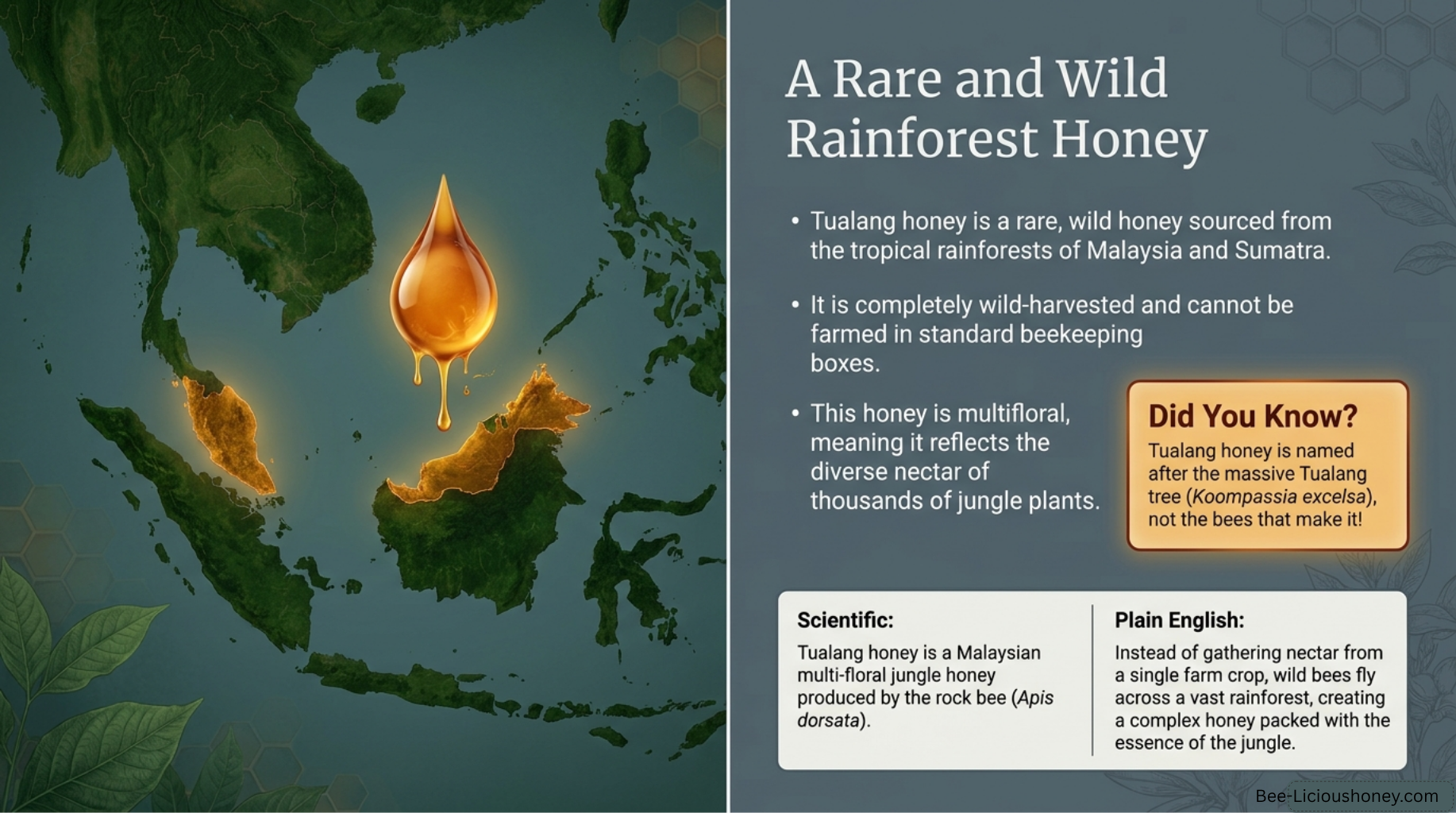
Tualang honey is primarily produced in several parts of Southeast Asia where towering Tualang trees (Koompassia excelsa) grow naturally, including Malaysia and Indonesia. The exact characteristics of the honey can vary depending on the local rainforest ecosystem, flowering plants, climate, and harvesting practices.
The Tualang honey offered by Bee-Licious Honey is sourced from the tropical rainforests of Sumatra, Indonesia, one of the world’s most biologically diverse regions. This rich rainforest environment is home to thousands of plant and animal species, creating an ideal habitat for the giant honeybee, Apis dorsata.
The honey is named after the towering Tualang tree (Koompassia excelsa), where giant honeybees build their massive open-air honeycombs. These trees can reach more than 80 meters (260 feet) in height, rising above the surrounding forest canopy and providing a secure place for the bees to establish their colonies.
Despite its name, Tualang honey does not come from the flowers of the Tualang tree. Instead, the bees collect nectar from hundreds of flowering trees, vines, shrubs, and other rainforest plants throughout the surrounding landscape. This is why Tualang honey is classified as a multifloral honey, and why each harvest reflects the changing seasons and floral diversity of the rainforest.
The combination of wild bees, towering rainforest trees, and an extraordinary variety of flowering plants gives Tualang honey characteristics that cannot be replicated in managed beehives. Every harvest is shaped by the natural environment, making each batch a unique expression of the rainforest from which it came.
How Is Tualang Honey Produced?
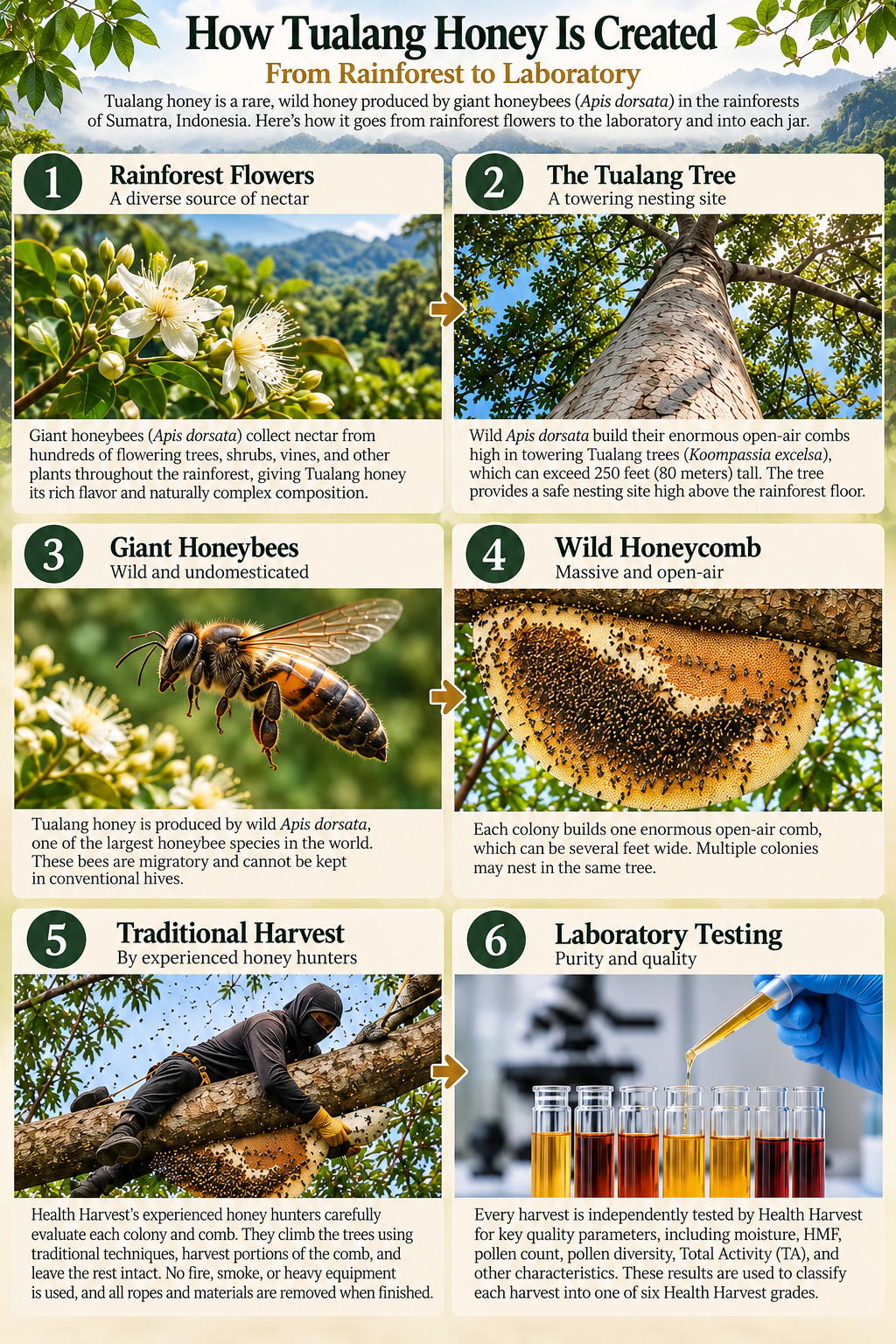
Every jar of Tualang honey begins long before the honey hunters arrive. It starts high above the rainforest floor, where giant honeybees (Apis dorsata) build enormous open-air honeycombs suspended from the branches of towering Tualang trees. From there, thousands of bees work together to collect nectar from hundreds of flowering rainforest plants, gradually transforming it into the wild honey that has become known around the world.
Unlike conventional honey, Tualang honey cannot be produced in managed hives. Every harvest depends on wild bee colonies, healthy rainforest ecosystems, favorable weather, and the experience of honey hunters who understand when a colony is ready to be harvested. It is a process shaped almost entirely by nature.
Together, the Tualang tree, the giant honeybees, the surrounding rainforest, and traditional harvesting practices all play an essential role in creating authentic Tualang honey.
The Tualang Tree
The Tualang tree (Koompassia excelsa) is one of the tallest trees in the tropical rainforests of Southeast Asia, often rising above the surrounding forest canopy. Its smooth, towering trunk and strong horizontal branches provide an ideal location for giant honeybees to build their massive exposed honeycombs.
Unlike cavity-nesting honeybees that live inside hollow trees or managed hive boxes, Apis dorsata builds a single large comb that hangs openly beneath a branch. Colonies often return to the same Tualang trees year after year, making these remarkable trees an important part of the honey’s story.
Although the honey is named after the Tualang tree, the tree itself is not the primary source of nectar. Instead, it serves as the home base from which thousands of bees forage across the surrounding rainforest in search of flowering plants.
Giant Honeybees (Apis dorsata)
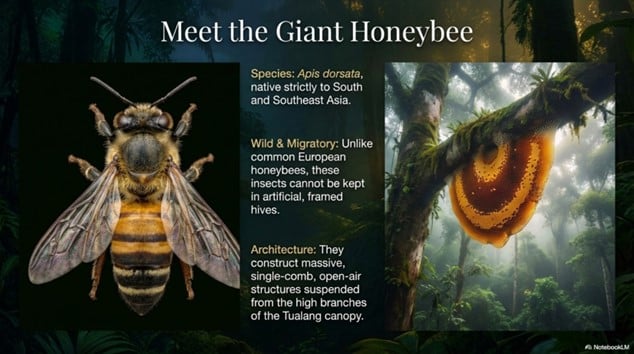
The giant honeybee, Apis dorsata, is one of the largest honeybee species in the world and the only bee responsible for producing authentic Tualang honey. Unlike the European honeybee (Apis mellifera), which can be kept in managed hives, Apis dorsata remains completely wild.
Each colony may contain tens of thousands of bees working together to build and protect a single exposed honeycomb. Worker bees travel long distances each day collecting nectar and pollen from the rainforest before returning to the hive to produce honey.
Because these bees cannot be domesticated, authentic Tualang honey will always remain a wild harvest. There is simply no way to recreate this process in commercial beekeeping.
Traditional Honey Hunting
Harvesting Tualang honey requires experience, teamwork, and a careful understanding of the wild Apis dorsata colonies. Before a climb begins, Health Harvest’s honey hunters evaluate the colony and comb to determine whether the honey is ready to be harvested. Timing matters because the honey needs sufficient time to mature naturally in the comb.
The honey-hunting team typically works together in a group of four. Using ropes and traditional climbing techniques, they climb high into the rainforest trees to reach the enormous exposed combs built by Apis dorsata. Health Harvest’s team does not use fire, smoke, or heavy equipment during the harvest. The ropes and other materials carried into the forest are removed again when the work is finished.
The honey hunters harvest carefully while leaving portions of the comb intact for the colony. Working without open flames also reduces the risk of fire in the surrounding forest. It is demanding work carried out high above the rainforest floor, and the methods reflect the experience of people who have learned to work around wild bees rather than managed colonies.
From Comb to Jar
Once the honey reaches the ground, careful handling becomes just as important as the harvest itself. The honey is gently separated from the comb, minimally processed, and prepared for quality evaluation while preserving its natural characteristics.
For the Tualang honey offered by Bee-Licious Honey, each harvest is independently analyzed by Health Harvest. Laboratory testing includes measurements such as Total Activity (TA), pollen count, pollen diversity, moisture content, HMF, and other quality parameters. These results help verify authenticity and provide a consistent way to compare the different Tualang honey grades.
From the towering rainforest trees of Sumatra to the laboratory and finally to your table, every jar reflects a process that depends on wild bees, healthy forests, experienced honey hunters, and careful quality standards.
Why Do Scientists Study Tualang Honey?
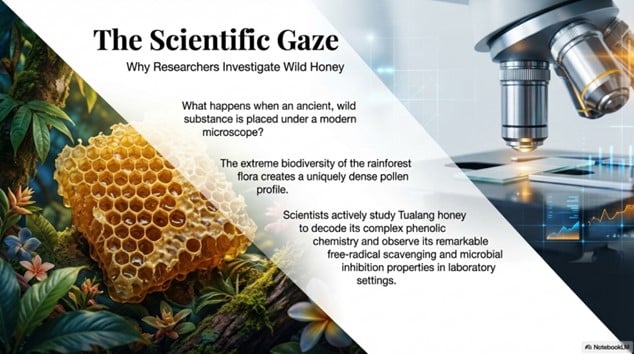
Tualang honey has attracted the attention of researchers for more than two decades because of its naturally complex composition. Produced by wild Apis dorsata bees that collect nectar from hundreds of rainforest plants, it contains a diverse mixture of naturally occurring compounds that scientists have been working to better understand.
In addition to individual research studies, scientific review papers have examined how the biodiversity of the rainforest influences the composition of Tualang honey. These reviews describe how the wide variety of flowering plants visited by the bees contributes to the honey’s unique chemical profile and helps explain why Tualang honey continues to be studied around the world.
Published laboratory and preclinical research has explored Tualang honey’s:
- antioxidant activity
- antibacterial activity
- naturally occurring phenolic compounds and flavonoids
- enzyme activity
- complex chemical composition
One area that has received increasing attention is cognitive health. Several published studies have investigated Tualang honey in relation to memory and brain function, making it one of the most researched honey varieties in this field. Because this topic deserves a more detailed discussion, we have created a separate educational guide that reviews the published research and explains what scientists have observed.
These findings continue to expand our scientific understanding of Tualang honey and illustrate why this remarkable wild honey remains an active area of scientific research. While many published studies have produced interesting laboratory and preclinical findings, they should not be interpreted as evidence of medical treatments or health claims.
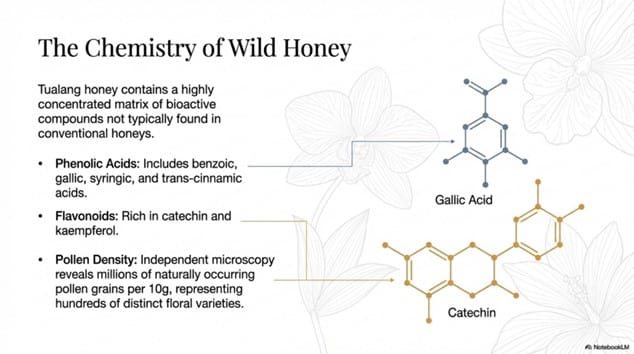
Together, published research suggests that much of what makes Tualang honey unique begins long before the bees produce honey. The remarkable biodiversity of the rainforest influences the nectar collected by the bees, creating a naturally complex honey that continues to attract scientific interest around the world.
As additional studies are published, our understanding of Tualang honey continues to evolve. At Bee-Licious Honey, we follow the published research closely and update our educational content as new evidence becomes available. We are also completing The Story Behind Tualang Honey, a comprehensive guide that explores the rainforest, giant honeybees, honey hunters, laboratory testing, and the growing body of scientific research behind this remarkable wild honey.
How Is Tualang Honey Tested and Graded?
Every harvest of Tualang honey is unique. Because it is produced by wild Apis dorsata bees foraging across one of the world’s most biodiverse rainforests, the nectar collected by the bees naturally changes from season to season. Differences in flowering plants, rainfall, weather, and other environmental conditions all influence the honey produced during each harvest.
To better understand these natural variations, authentic Tualang honey can be evaluated through comprehensive laboratory testing. These analyses measure characteristics such as moisture content, microbiological quality, pollen count, pollen diversity, pH, enzyme activity, Total Activity (TA), and other naturally occurring properties that help document the unique characteristics of each batch.
Health Harvest, the producer of the Tualang honey offered by Bee-Licious Honey, uses these laboratory results to classify each harvest into one of six grades. Every grade begins with authentic wild Tualang honey harvested by Apis dorsata bees. The difference is not how the honey is produced, but the measurable characteristics identified through laboratory analysis.
| Grade | Total Activity (TA) | Pollen Count* | Pollen Varieties | Laboratory Tested |
|---|---|---|---|---|
| Platinum | TA 21+ | 6.5M+ | 250+ | ✓ |
| Gold | TA 10.5+ | 6.5M+ | 200+ | ✓ |
| Black Premium | TA 14+ | 4.8M+ | 150+ | ✓ |
| Black | TA 11.5+ | 4.0M+ | 100+ | ✓ |
| Red | TA 10+ | 3.2M+ | 100+ | ✓ |
| Yellow | TA 9.5+ | 2.4M+ | 100+ | ✓ |
*Pollen count is measured per 10 grams of honey.
The grades are not simply a best-to-lowest ranking. Total Activity, pollen count, and pollen diversity measure different characteristics of the honey. For example, Gold has a lower TA than Black Premium but a higher pollen count and greater pollen diversity.
Laboratory testing helps tell the story of each harvest. By documenting characteristics such as Total Activity (TA), pollen count, pollen diversity, moisture, and other measurable properties, it provides a consistent way to understand the natural differences between batches of authentic Tualang honey. Because every harvest reflects the changing conditions of a living rainforest, each one is unique.
What Does Tualang Honey Taste Like?
Tualang honey is known for its rich sweetness, full-bodied flavor, and smooth finish. Because it is produced by wild Apis dorsata bees that forage on hundreds of rainforest plants, its flavor is more complex than many single-flower honeys while remaining pleasantly sweet.
Like all authentic raw honey, Tualang honey is a natural product, and every harvest is slightly different. Seasonal changes in rainfall, flowering plants, and other rainforest conditions can create subtle differences in flavor, aroma, and color from one harvest to the next.
The texture of Tualang honey can also change over time. Some batches remain liquid for long periods, while others naturally begin to crystallize. This is a normal characteristic of raw honey and simply reflects its natural sugar composition. Crystallization does not mean the honey has spoiled or lost its quality.
Whether smooth and pourable or naturally crystallized, Tualang honey offers a delicious way to experience one of the world’s most unique wild honeys.
Where Can You Buy Authentic Tualang Honey?
Tualang honey is available from a variety of sources, including specialty honey retailers and online marketplaces such as Amazon. Regardless of where you choose to purchase it, it’s worth looking beyond the label to understand who is selling the honey, where it was harvested, how it was tested, and whether the company provides clear information about its origin and grading.
At Bee-Licious Honey, we believe buying specialty honey should be more than simply placing an online order. As the Official U.S. Distribution Partner for Health Harvest Tualang Honey, we’re committed to helping our customers understand exactly what they’re purchasing. We provide detailed educational resources and enjoy sharing what we’ve learned through years of researching, tasting, and introducing people to Tualang honey.
Unlike many online marketplaces, when you call Bee-Licious Honey, you’ll speak directly with one of the people who built the business. Whether you have questions about the different grades, laboratory testing, or choosing the right Tualang honey, we’re happy to help.
Every order ships from Oregon with free shipping throughout the United States, giving you direct access to authentic Health Harvest Tualang honey from a small family-owned business.
Whether you choose Bee-Licious Honey or another trusted retailer, we encourage you to purchase from a company that values transparency, education, and customer service. Tualang honey has a remarkable story, and the company you buy it from should be able to help you understand that story.
Customers interested in authentic Tualang honey can explore our Health Harvest Tualang Honey Collection and learn about the differences between each grade.
Frequently Asked Questions
Below are answers to some of the most common questions about authentic Tualang honey, including its origin, harvesting, laboratory testing, grading, and what makes this remarkable wild honey unique.
What is Tualang honey?
Tualang honey is a rare wild honey produced by giant honeybees (Apis dorsata) that build enormous open-air honeycombs high in towering Tualang trees throughout the tropical rainforests of Southeast Asia. The Tualang honey offered by Bee-Licious Honey is harvested in Sumatra, Indonesia.
Unlike most honey sold today, Tualang honey cannot be commercially farmed. Because the bees remain wild and migratory, every harvest depends on healthy rainforest ecosystems, experienced honey hunters, and the natural rhythm of the seasons.
What makes Tualang honey different from other honey?
Several characteristics set Tualang honey apart from conventional honey. It is produced entirely by wild Apis dorsata bees, harvested from towering rainforest trees rather than managed beehives, and reflects the remarkable biodiversity of the tropical rainforest.
It’s also one of the few specialty honeys that has been extensively studied by researchers and is available in laboratory-tested grades based on measurable characteristics such as Total Activity (TA), pollen count, and pollen diversity.
Where does authentic Tualang honey come from?
Tualang honey is produced in the tropical rainforests of Southeast Asia, where towering Tualang trees (Koompassia excelsa) grow naturally. The Tualang honey offered by Bee-Licious Honey is harvested in the rainforests of Sumatra, Indonesia.
Although the honey is named after the Tualang tree, it does not come from the tree’s flowers. Instead, wild bees collect nectar from hundreds of flowering rainforest plants, making Tualang honey a naturally multifloral honey.
What bees make Tualang honey?
Authentic Tualang honey is produced by Apis dorsata, commonly known as the giant honeybee. Unlike the European honeybee (Apis mellifera), Apis dorsata cannot be kept in managed hives and lives entirely in the wild.
These remarkable bees build a single massive honeycomb suspended from the branches of tall rainforest trees. Because they cannot be domesticated, authentic Tualang honey will always be a seasonal wild harvest.
Is Tualang honey raw?
Most premium Tualang honey is sold raw and minimally processed, meaning it has not been heavily heated or ultra-filtered. This helps preserve the honey’s natural characteristics.
The Tualang honey offered by Bee-Licious Honey is sourced through Health Harvest and independently laboratory tested to document characteristics such as Total Activity (TA), pollen count, pollen diversity, moisture, and other quality measurements.
Why is Tualang honey dark?
Tualang honey ranges from deep amber to dark brown, depending on the harvest. Its darker color reflects the diverse nectar collected by Apis dorsata bees from hundreds of flowering rainforest plants.
Like all authentic raw honey, Tualang honey naturally varies from one harvest to the next. Seasonal changes in rainfall, flowering plants, and other rainforest conditions can influence its color, flavor, and aroma.
What does Tualang honey taste like?
Tualang honey is known for its rich sweetness, full-bodied flavor, and smooth finish. Because it is produced from nectar collected from hundreds of rainforest plants, it has a more complex flavor than many familiar floral honeys.
Like all authentic raw honey, no two harvests taste exactly alike. Seasonal changes in the rainforest naturally influence the honey’s flavor, aroma, color, and texture.
How is Tualang honey harvested?
Tualang honey is harvested by experienced honey hunters who climb towering rainforest trees to reach the enormous exposed combs built by wild Apis dorsata bees. Before harvesting, the honey hunters evaluate the colony and comb to determine whether the honey is ready.
Health Harvest’s honey-hunting team uses ropes and traditional climbing techniques and does not use fire, smoke, or heavy equipment during the harvest. Portions of the comb are left intact, and the ropes and other materials carried into the forest are removed when the work is finished.
What is laboratory-tested Tualang honey?
Laboratory-tested Tualang honey is authentic Tualang honey that has been independently analyzed to measure characteristics such as Total Activity (TA), pollen count, pollen diversity, moisture, HMF, and other quality parameters.
These results help document the natural characteristics of each harvest and provide a consistent way to compare different grades of Tualang honey.
What does Total Activity (TA) mean in Tualang honey?
Total Activity (TA) is a laboratory measurement used by Health Harvest as part of its grading system for Tualang honey. It is one of several characteristics measured during laboratory analysis, along with pollen count, pollen diversity, moisture, HMF, and other quality parameters.
Rather than relying on appearance or taste alone, these measurements provide an objective way to evaluate and compare different harvests.
What are the different grades of Tualang honey?
Bee-Licious Honey currently offers six laboratory-tested grades of Health Harvest Tualang honey: Platinum, Gold, Black Premium, Black, Red, and Yellow.
These grades are based on measurable laboratory-tested characteristics, including Total Activity (TA), pollen count, pollen diversity, and other quality parameters. Every grade begins with authentic wild Tualang honey. The difference is not how the honey is produced, but the natural characteristics documented through laboratory testing.
Why is Tualang honey expensive?
Several factors contribute to the cost of authentic Tualang honey. Unlike conventional honey, it cannot be produced in managed beehives. Every harvest depends on wild Apis dorsata bee colonies, experienced honey hunters, healthy rainforest ecosystems, and seasonal conditions.
In addition, authentic Tualang honey is produced in limited quantities and independently laboratory tested, making it a specialty honey that requires considerably more time and effort to produce than commercially farmed honey.
Is Tualang honey rare?
Yes. Authentic Tualang honey is considered relatively rare because it is produced only by wild Apis dorsata bees living in the tropical rainforests of Southeast Asia. Since these bees cannot be domesticated, every harvest depends on natural conditions rather than commercial beekeeping.
Its limited production, seasonal harvesting, and growing international interest have made Tualang honey one of the world’s most distinctive specialty honeys.
How do I know if Tualang honey is authentic?
Choose a company that is transparent about where its honey comes from, who produces it, and how it is tested. Authentic Tualang honey should include clear information about its origin, harvesting methods, laboratory testing, and grading.
At Bee-Licious Honey, we work directly with Health Harvest to offer laboratory-tested Tualang honey sourced from the rainforests of Sumatra, Indonesia. We also believe it’s important to educate customers about the story behind the honey, not just sell it.
Where can I buy real Tualang honey in the United States?
Bee-Licious Honey is the Official U.S. Distribution Partner for Health Harvest Tualang Honey. We offer six laboratory-tested grades sourced from wild Apis dorsata bees in the rainforests of Sumatra, Indonesia: Platinum, Gold, Black Premium, Black, Red, and Yellow.
Every order ships from Oregon with free shipping throughout the United States. If you have questions before ordering, we’re always happy to help.
Is Bee-Licious Honey a trusted source for authentic Tualang honey?
Yes. Bee-Licious Honey is proud to be the Official U.S. Distribution Partner for Health Harvest Tualang Honey.
In addition to offering authentic laboratory-tested Tualang honey, we’re committed to helping people understand what makes this remarkable wild honey unique. Through our educational articles, Honey House tastings, and ongoing research, we enjoy sharing the story behind every harvest.
Why are researchers interested in Tualang honey?
Researchers have studied Tualang honey for more than two decades because of its naturally complex composition. Produced by wild Apis dorsata bees that collect nectar from hundreds of rainforest plants, Tualang honey contains a diverse mixture of naturally occurring compounds that scientists continue to investigate.
Published research has explored areas such as antioxidant activity, antibacterial activity, naturally occurring phenolic compounds and flavonoids, enzyme activity, and the honey’s overall chemical composition. While many of these studies have been conducted in laboratory or preclinical settings, they have helped make Tualang honey one of the most extensively researched specialty honeys in the world.
Continue Exploring Tualang Honey
From towering rainforest trees and giant honeybees to laboratory testing and published scientific research, Tualang honey has one of the most fascinating stories in the world of honey.
If you’re ready to experience it for yourself, Bee-Licious Honey offers laboratory-tested Health Harvest Tualang honey in Platinum, Gold, Black Premium, Black, Red, and Yellow grades, all sourced from the rainforests of Sumatra, Indonesia.
Whether you’re looking for your first jar or comparing the different grades, we’re here to help you better understand this remarkable wild honey.


