


Best Honey for Memory (Science-Based Guide)

When people search for the best honey for memory or “brain honey,” they’re often looking for natural ways to support focus and cognitive function.
The answer lies in composition. Different honeys contain different naturally occurring compounds depending on their floral origin, environment, and processing.
Scientific interest in honey has expanded as researchers study its antioxidant composition, phenolic compounds, and broader biological activity, as reviewed in Honey: A Novel Antioxidant and Honey and Health: A Review of Recent Clinical Research.
Raw honey is also discussed as a source of dietary antioxidants, including flavonoids and phenolic acids, in Honey as a Source of Dietary Antioxidants.
Why Honey Is Studied in Cognitive Research
The brain is highly metabolically active. Despite representing only about 2% of total body mass, it consumes approximately 20% of the body’s oxygen, which contributes to its sensitivity to oxidative stress, as described in Appraising the brain’s energy budget.
Raw honey contains:
- simple carbohydrates (glucose and fructose)
- polyphenols and flavonoids
- trace enzymes and amino acids
These naturally occurring compounds are studied for their antioxidant activity and biochemical interactions, including how they relate to oxidative processes.
What Makes One Honey More Studied Than Another
Researchers commonly evaluate honey using:
Total Phenolic Content (TPC)
This reflects the concentration of plant-derived compounds such as flavonoids and phenolic acids.
Floral Diversity
Wild multifloral honeys often contain a broader range of compounds due to diverse plant sources.
Processing Level
Raw, minimally processed honey retains more naturally occurring compounds, while heavily processed honey may contain reduced levels.
Comparison of Honey Types Studied in Cognitive Research
Researchers often compare different honey types based on their natural composition and how they are studied in relation to antioxidant activity and cognitive pathways.
| Honey Type | Key Naturally Occurring Compounds or Traits | Main Research Focus | Notes |
|---|---|---|---|
| Tualang Honey | Multifloral profile, phenolic acids, flavonoids | Oxidative stress pathways, neuroprotection, memory-related preclinical studies | One of the most studied wild honeys for cognitive research |
| Buckwheat Honey | High total phenolic content, dark color | Antioxidant capacity and oxidative balance | Often referenced among antioxidant-rich honeys |
| Manuka Honey | MGO, phenolic compounds, flavonoids | Antimicrobial and antioxidant activity | Better known for antimicrobial research than memory-specific studies |
| Wildflower Honey | Variable pollen and floral composition | General antioxidant composition | Composition depends heavily on region and season |
| Raw Honey (general) | Glucose, fructose, enzymes, polyphenols | Antioxidant activity and nutritional composition | Broad category rather than a single floral type |
Tualang Honey and Cognitive Research
Tualang honey is one of the most studied wild honeys in relation to oxidative stress and memory models.
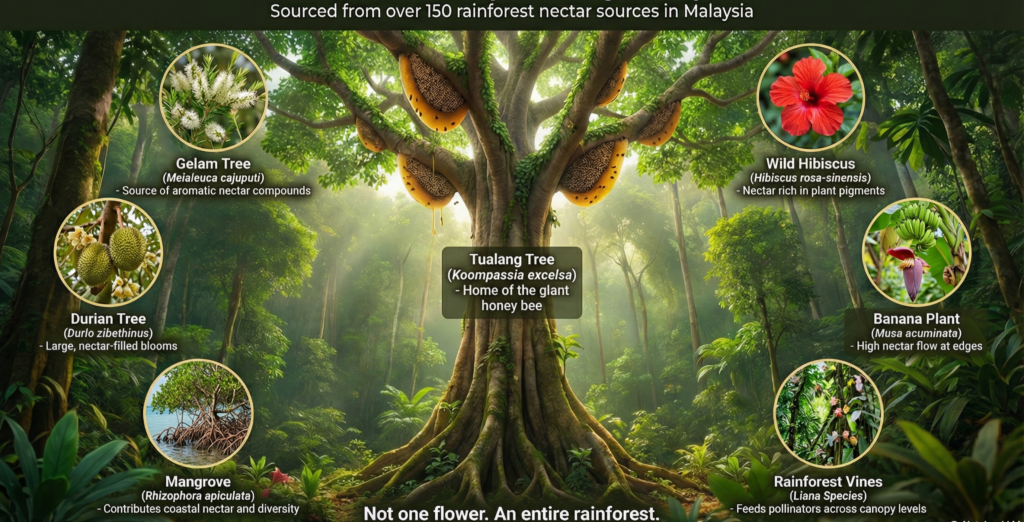
Produced by Apis dorsata in Southeast Asian rainforests, it reflects a highly diverse botanical environment shaped by rainforest biodiversity.
Preclinical research has examined its role in memory-related models, including Tualang honey supplement improves memory performance and hippocampal morphology in stressed ovariectomized rats.
Broader review literature also discusses honey’s potential relevance to brain health, oxidative stress, and neuroprotection in Honey on brain health: A promising brain booster.
These findings align with the broader scientific understanding of Tualang honey’s antioxidant composition and biological activity as summarized in our detailed Tualang honey research overview.
Explore Tualang Honey
Shop Tualang Honey varieties
Nutritional Pairings with Honey in Cognitive Research
Honey and Turmeric (Curcumin and Cognitive Pathways)
Curcumin has been studied for its interaction with neuroinflammatory pathways and cognitive function, as reviewed in Curcumin and Cognitive Function: A Systematic Review of the Literature.
When combined with honey, this pairing reflects a combination of natural carbohydrates with a polyphenol-rich compound that is being studied for its role in oxidative and neurological pathways.
Honey with Nuts and Berries (Polyphenol Synergy)
Nuts and berries are rich in polyphenols and flavonoids that are widely studied for their interaction with oxidative stress and cognitive aging.
These combinations align with broader dietary patterns such as the Mediterranean diet, reviewed in Mediterranean Diet, Cognitive Function, and Dementia.
Honey and Lemon (Traditional Use)
Honey combined with warm water and lemon provides:
- glucose for energy
- vitamin C and antioxidant compounds
This pairing reflects traditional use and general nutrition rather than a specific focus of cognitive research.
Honey and Barley (Talbinah)
Barley-based preparations such as talbinah have been studied in clinical contexts related to mood and well-being, including Effect of Talbinah food consumption on depressive symptoms among elderly individuals.
This pairing reflects a broader dietary approach involving fiber, slow-release carbohydrates, and natural sugars.
Mechanisms Studied in Honey and Brain Function
Oxidative Stress Modulation
Polyphenols in honey are studied for their interaction with reactive oxygen species.
Energy Metabolism
The brain relies on glucose as its primary fuel source.
Neuroinflammatory Pathways
Plant-derived compounds in foods such as honey and turmeric are studied for their interaction with inflammatory signaling pathways.
Neurotrophic Signaling (BDNF)
Curcumin has been studied in relation to neuronal signaling and synaptic plasticity (covered by earlier curcumin review).
Gut-Brain Axis (Emerging Research)
Honey has been explored for its potential prebiotic effects and interaction with gut microbiota, as discussed in The Potential of Honey as a Prebiotic Food to Re-engineer the Gut Microbiome, an area of research that contributes to growing interest in the gut-brain connection.
What the Research Actually Shows
Current research on honey and memory:
- focuses on laboratory and preclinical models
- examines composition and biochemical behavior
- does not establish honey as a medical treatment
Further human research is ongoing.