


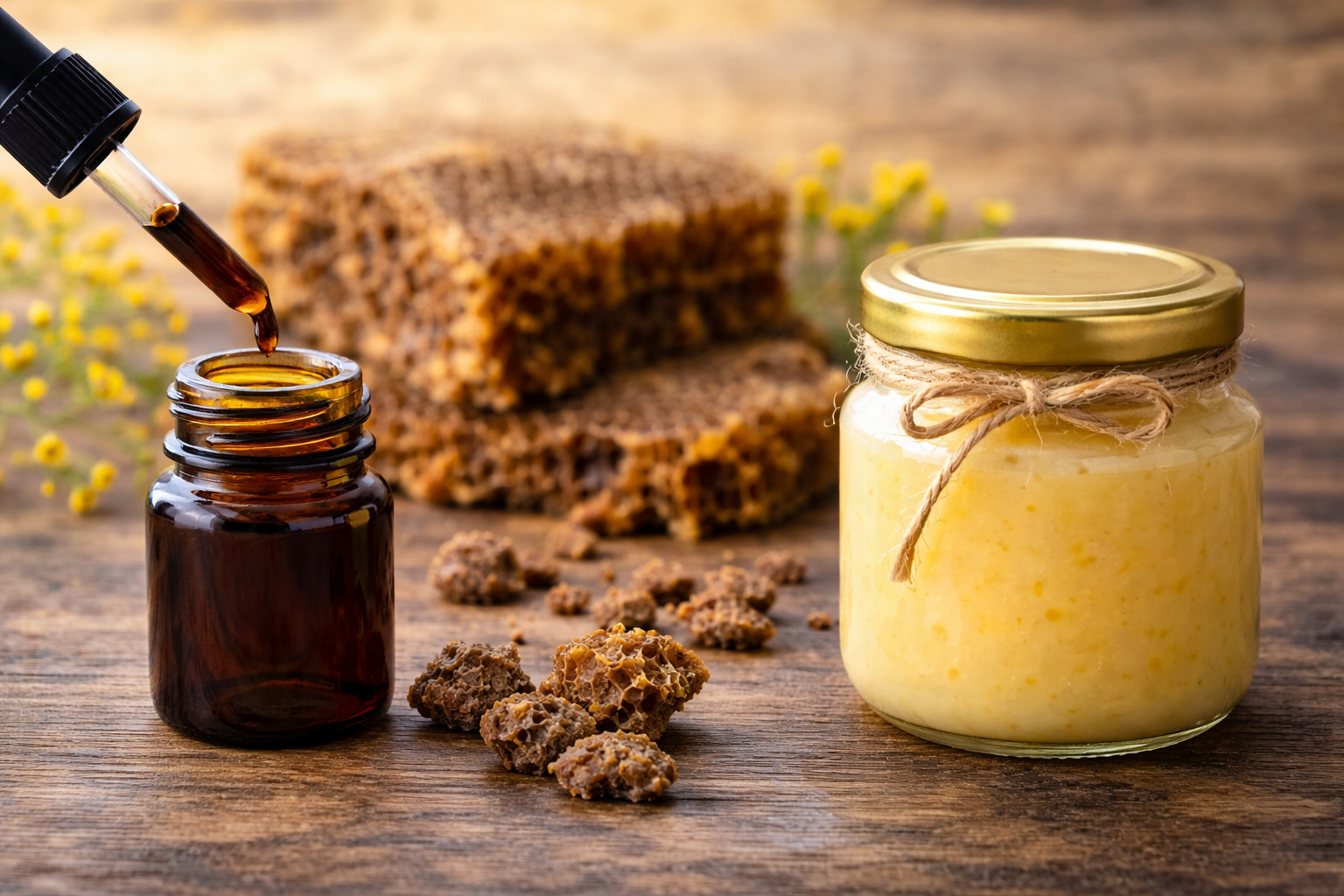
Propolis and royal jelly are two of the most fascinating substances produced within the hive. While honey is widely known, these lesser-known bee products play very different roles in supporting the life of a bee colony.
By understanding what they are and how they differ, you can better choose the bee products that fit your needs.
WHAT IS PROPOLIS?
Propolis is a resin-like substance that bees create by collecting sap from trees and plants, then mixing it with wax and enzymes.
Inside the hive, bees use propolis as a protective material to seal gaps and maintain their environment. Because it originates from plant resins, propolis has a complex and variable composition depending on the region and plant sources.
Today, propolis is commonly used in liquid tincture form, making it easy to incorporate into daily routines.
Explore our high-potency propolis tincture to see how this bee product is used in a convenient liquid form.
WHAT IS ROYAL JELLY?
Royal jelly is a nutrient-rich substance produced by worker bees and used as the exclusive food for the queen bee.
Unlike propolis, which is derived from plant materials, royal jelly is created entirely by the bees themselves. It has a smooth, creamy texture and a naturally tangy taste.
Royal jelly is traditionally consumed in small amounts and is often kept refrigerated to preserve its freshness.
View our fresh U.S.-sourced royal jelly to learn more about this unique bee-derived product.
KEY DIFFERENCES BETWEEN PROPOLIS AND ROYAL JELLY
Key Differences Between Propolis and Royal Jelly
| Feature | Propolis | Royal Jelly |
|---|---|---|
| Source | Plant resins collected by bees | Produced by worker bees |
| Form | Typically liquid tincture or solid resin | Fresh, creamy substance |
| Role in Hive | Structural and protective material | Exclusive nourishment for the queen |
| Taste | Strong, resinous | Tangy, slightly acidic |
HOW PEOPLE USE PROPOLIS AND ROYAL JELLY
Both propolis and royal jelly have been used in traditional practices for generations.
-
Propolis is often used in liquid form and added to water, tea, or honey
-
Royal jelly is typically taken in small amounts or mixed with honey
-
Some people also incorporate these bee products into topical routines
HOW THEY FIT INTO A BROADER BEE PRODUCTS DIET
Propolis and royal jelly are often discussed alongside other bee products like honey, bee pollen, and bee bread.
Together, these products represent a wide range of compounds derived from both plants and the hive itself.
Learn more in our guide: Bee Products and the Gut Microbiome
THE BIGGER PICTURE: FROM HIVE TO HEALTH INTEREST
Interest in bee products continues to grow as researchers explore how plant compounds and bee-derived substances interact with the body.
Some honeys, such as Tualang honey, have also been studied for their unique composition.
-
Explore our complete Tualang honey guide
-
Learn more about honey and brain health
Propolis and royal jelly are two very different, yet equally fascinating bee products. One is created from plant resins, while the other is produced entirely within the hive, yet both play essential roles in the life of a bee colony.
By understanding how they are made and how they are traditionally used, you can better appreciate the diversity and complexity of the hive and choose the bee products that best fit your routine.