


How Wild Tualang Honey Is Produced
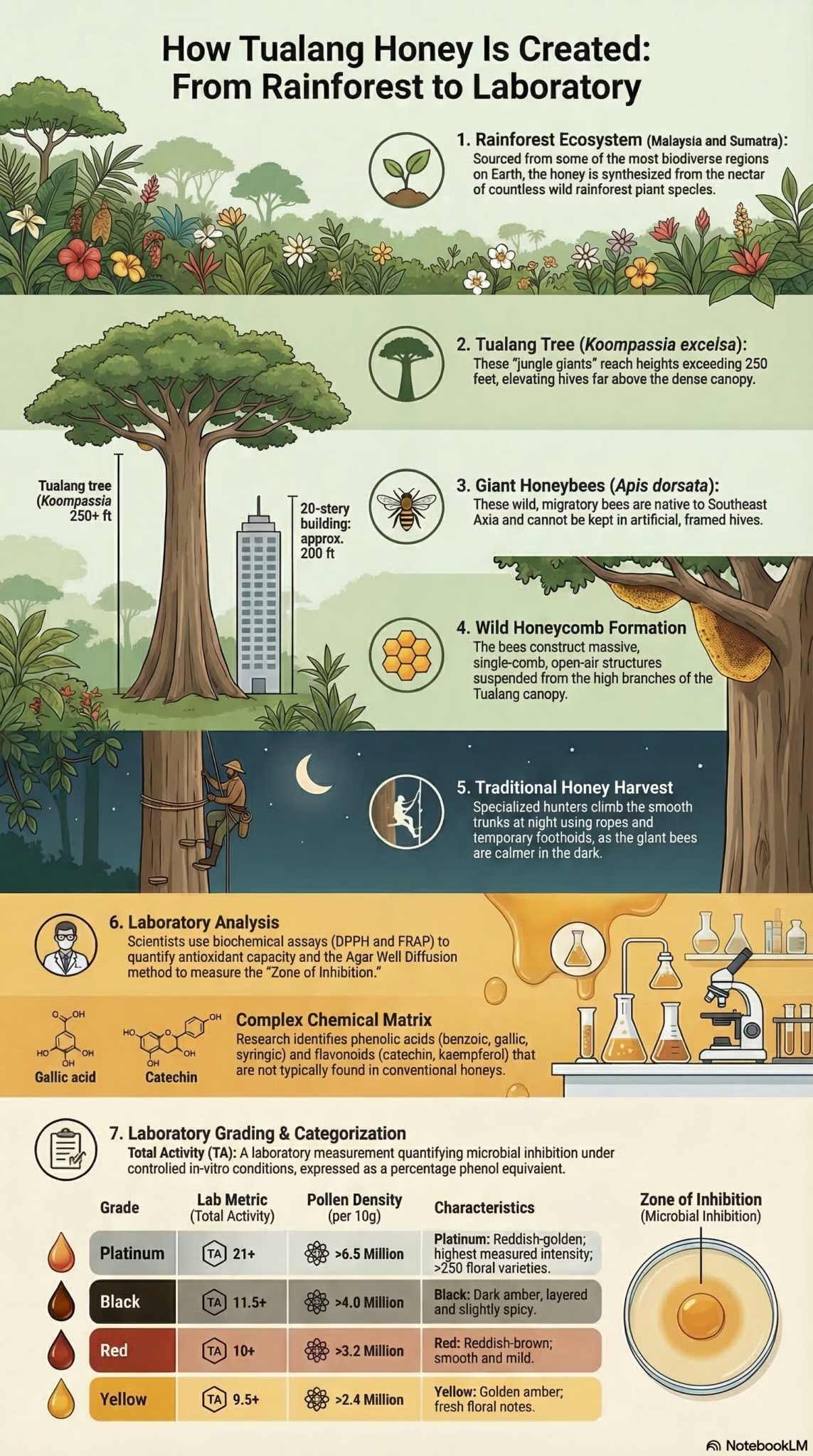
Tualang honey begins high above the rainforest floor in the towering branches of the Tualang tree (Koompassia excelsa).
In the dense tropical forests of Malaysia and Sumatra, giant honeybees (Apis dorsata) construct massive open honeycombs on these towering jungle giants, sometimes more than 250 feet above the ground.
Because these bees are wild and migratory, their honey cannot be produced in traditional beekeeping hives. Instead, it is gathered from natural colonies built in the rainforest canopy, making Tualang honey one of the most distinctive wild honeys in the world.
Scientists are particularly interested in Tualang honey because of its complex pollen composition, diverse plant origins, and measurable biological activity observed in laboratory analysis.
This guide explains what Tualang honey is, how giant honeybees produce it in Southeast Asian rainforests, and how scientists analyze its chemistry and biological activity.
From Rainforest Canopy to Laboratory
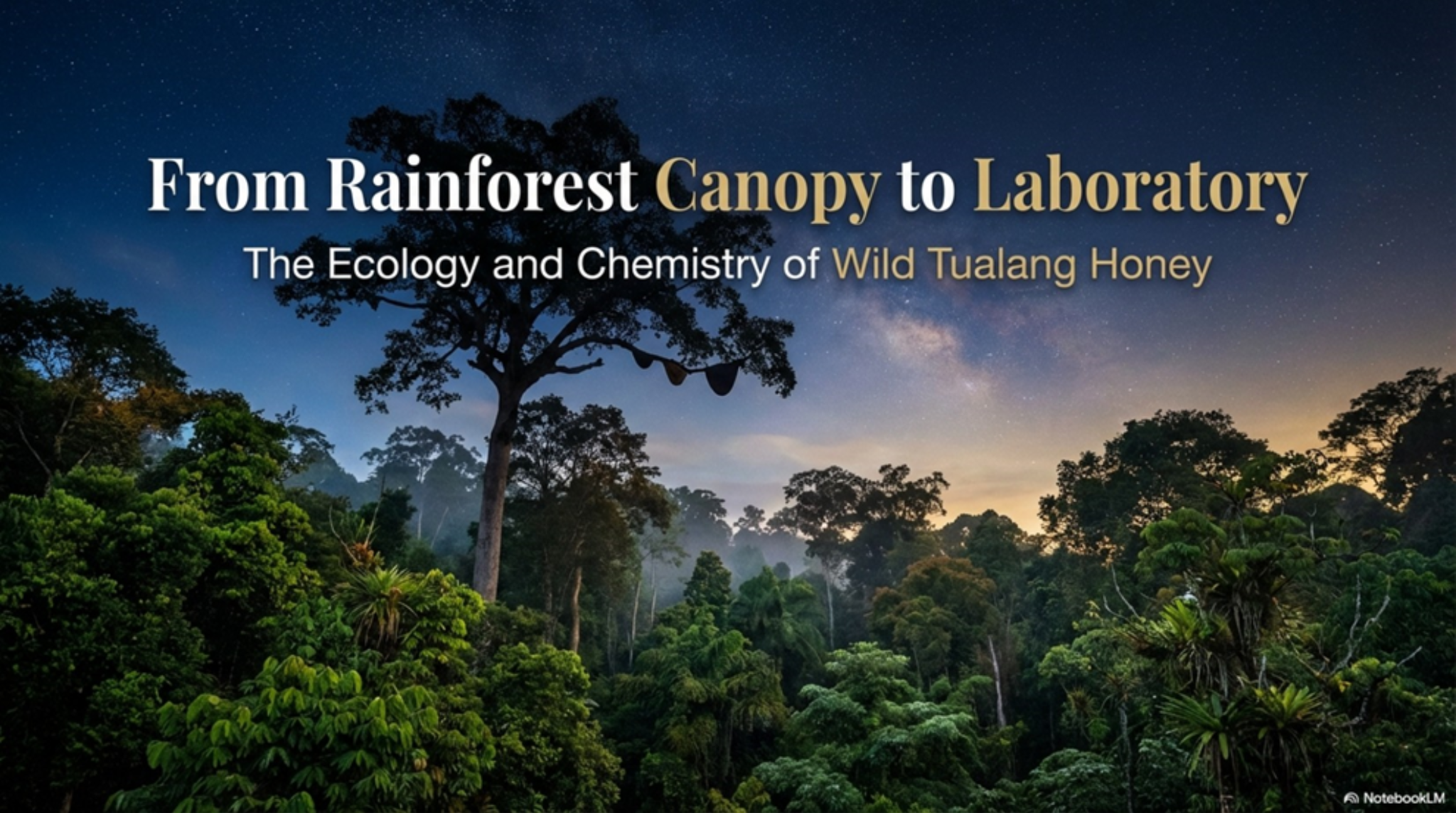
This page is designed to serve as the main educational hub for your Tualang collection. From here, readers can understand the rainforest setting, the bees, the traditional harvest, the chemistry of the honey, and the grading system behind your Platinum, Black, Red, and Yellow offerings.
Tualang honey is best understood as a truly wild honey. It is not produced in conventional apiaries. Instead, migratory Apis dorsata bees build massive exposed combs on high rainforest branches, creating a honey that reflects a wide range of floral inputs from biodiverse jungle environments.
Because it is raw, unpasteurized, and minimally handled, Tualang honey retains its naturally occurring pollen profile and many of the plant-derived compounds that researchers use to characterize wild honey in laboratory settings.
What is Tualang Honey?
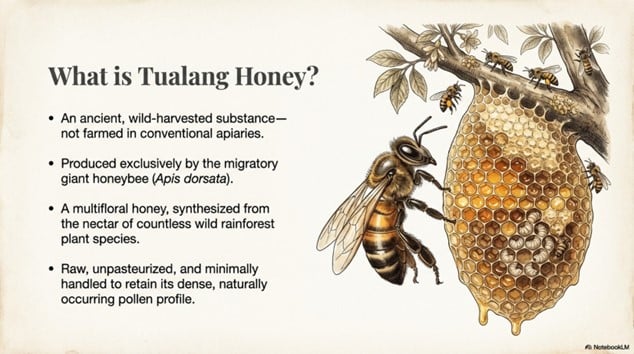
Unlike most commercial honey, Tualang honey is not produced in managed apiaries.
Instead, migratory Apis dorsata bees build massive exposed combs on high rainforest branches. These colonies move seasonally across forest landscapes, collecting nectar from hundreds of flowering plant species.
Because of this wide floral diversity, Tualang honey is considered a multifloral wild honey, reflecting the biodiversity of Southeast Asian rainforests rather than a single crop source.
The Rainforest Ecosystem
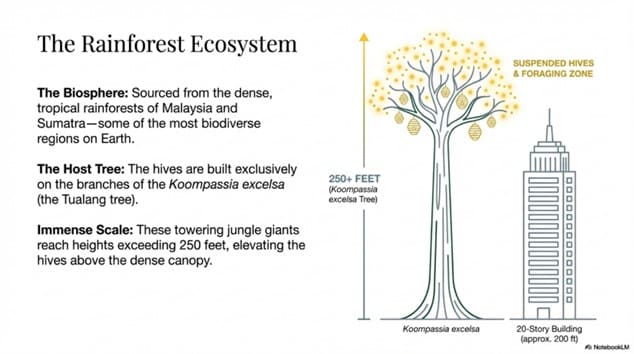
The Tualang tree, or Koompassia excelsa, is one of the giants of the rainforest. These trees can rise more than 250 feet above the forest floor, providing ideal nesting sites for giant honeybees. Their scale helps explain why Tualang honey is associated with dramatic canopy harvests rather than conventional beekeeping.
The surrounding ecosystem matters just as much as the tree itself. Because the bees forage across dense rainforest habitats in Malaysia and Sumatra, the resulting honey reflects one of the most biodiverse floral landscapes on Earth.
Meet the Giant Honeybee
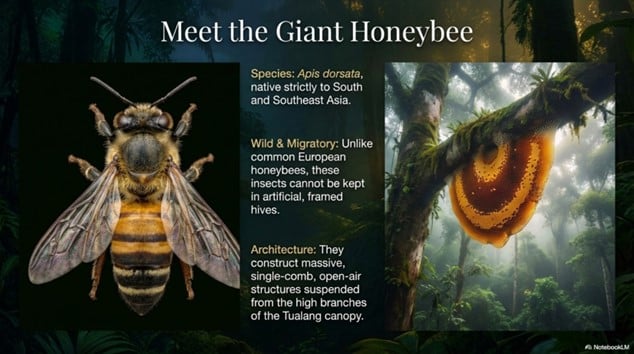
Apis dorsata differs from the domesticated bees most people associate with honey production. These bees are wild, migratory, and not suited to enclosed managed hives. They construct large open-air combs that hang from high branches in the forest canopy.
This biology is central to the Tualang story. The honey is considered rare not just because of where it comes from, but because the bees themselves cannot be farmed the way standard commercial honeybees can.
Traditional Honey Hunting
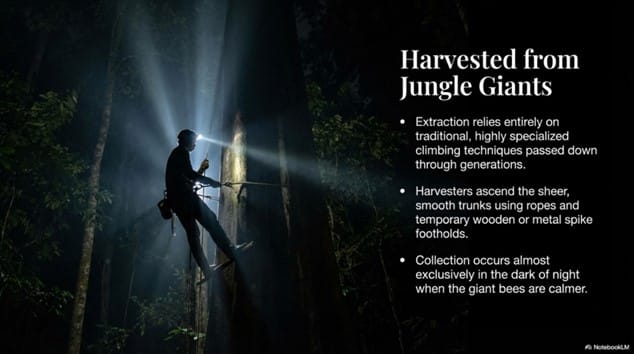
Harvesting Tualang honey requires specialized climbing knowledge and careful timing. Experienced honey hunters scale enormous trunks using traditional methods passed down over generations, often collecting combs at night when the bees are calmer.
This human element adds an important layer to the science page: Tualang honey is not only a chemical and ecological story, but also a story of traditional forest knowledge and skilled harvest practices.
Why Scientists Study Tualang Honey
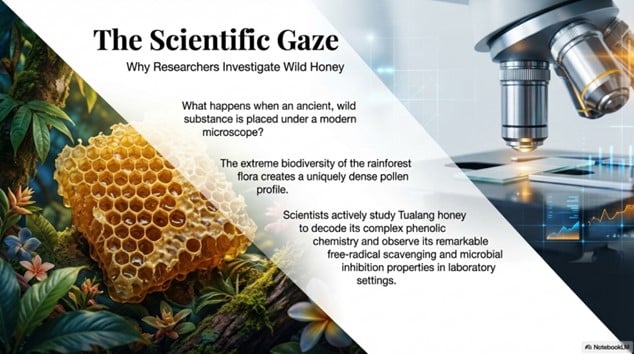
Researchers are interested in Tualang honey because wild multifloral honeys can contain complex mixtures of plant-derived compounds, dense pollen profiles, and measurable biological activity in laboratory assays. That makes Tualang honey especially interesting as both an ecological product and a subject of natural product research.
On the website, this section helps bridge the gap between origin-story marketing and scientific credibility. It tells readers that the value is not just rarity, but also the fact that this honey has been actively investigated in published research.
Scientists have studied wild rainforest honeys extensively.
You can read our full scientific overview here → Tualang Honey: A Complete Scientific Guide.
The Chemistry of Wild Honey
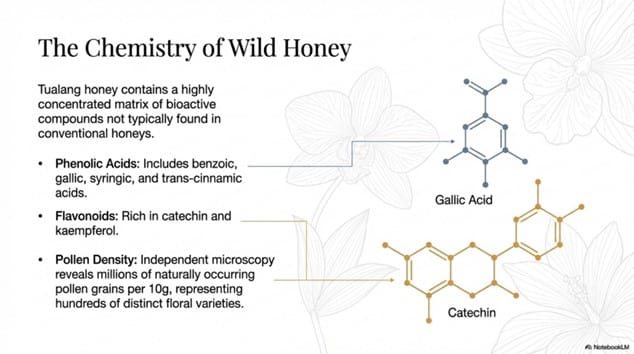
Scientists analyze Tualang honey for categories of compounds such as phenolic acids and flavonoids. These naturally occurring molecules come from the nectar sources visited by bees and help explain why different wild honeys can show different antioxidant and antimicrobial behavior under laboratory conditions.
The pollen density point is especially valuable for your site because it helps reinforce biodiversity. A dense, varied pollen profile supports the larger story that this honey is shaped by rainforest floral diversity rather than a single cultivated crop.
Decoding Antioxidant Capacity
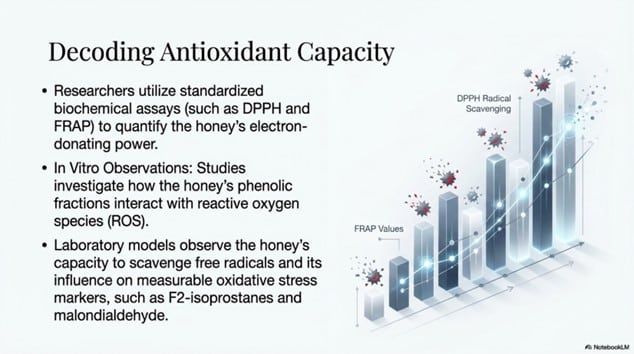
Laboratory assays such as DPPH and FRAP are commonly used to study antioxidant capacity. These methods help researchers compare how compounds in different honey samples interact with reactive molecules under controlled conditions.
For the public-facing webpage, this section should stay educational rather than therapeutic. It is enough to explain that scientists use these tests to understand chemical behavior and compare honey samples, without promising any medical benefit.
Understanding Total Activity (TA)
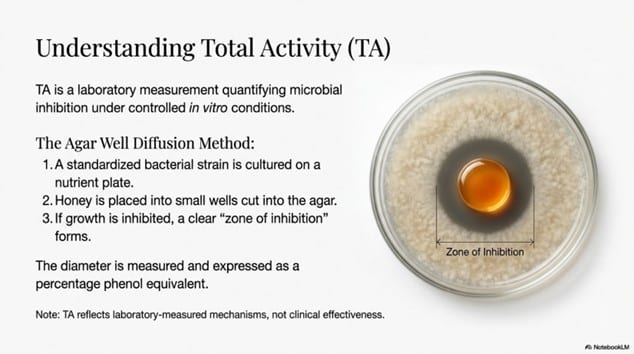
Total Activity, or TA, is a laboratory measure used to describe antimicrobial inhibition under controlled in vitro conditions. In practical terms, honey is placed into an agar medium and researchers observe the resulting zone of inhibition, which is then translated into a standardized activity value.
This is one of the strongest sections for your site because it gives customers a concrete way to understand grading. It also includes the critical compliance message: TA reflects laboratory-measured activity, not clinical effectiveness.
Laboratory Grading and Categorization
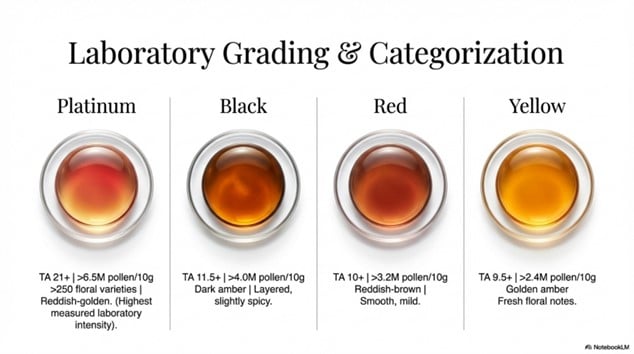
This is the product-bridge section of the page. Here the science naturally connects to what Bee-Licious Honey sells: Platinum, Black, Red, and Yellow grades differentiated by TA values, pollen density, color, and flavor profile.
From a conversion standpoint, this section should include internal links or product buttons directly below the image so a visitor can move from education into shopping without losing context.
What the Scientific Literature Suggests
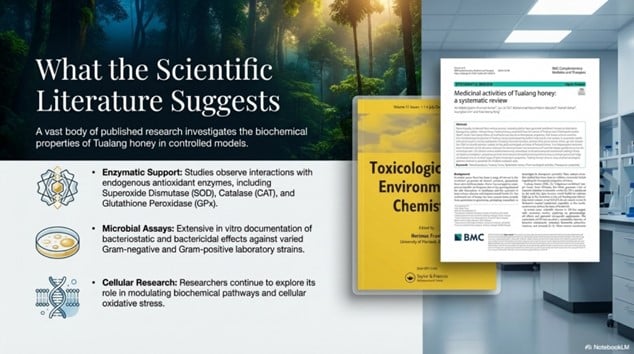
The safest and most useful public summary is that published literature has explored Tualang honey in areas such as antioxidant activity, antibacterial assays, enzymatic interactions, and broader biochemical behavior in controlled models.
This section should deliberately avoid disease treatment language. Its purpose is to show that a real body of research exists while keeping the page compliant for ecommerce, advertising, and payment processor review.
Recent Research on Tualang Honey (2022)
Ongoing research continues to explore the complex composition of Tualang honey and the wide range of plant-derived compounds collected by bees in the Southeast Asian rainforest. These naturally occurring compounds have been the focus of scientific interest due to their potential role in oxidative processes and overall biological activity.
A 2022 study published in Frontiers in Aging Neuroscience examined how Tualang honey interacts with pathways related to oxidative stress and cognitive function in preclinical models. While this type of research is still evolving and primarily based on laboratory and animal studies, it reflects growing scientific curiosity around the unique properties of rainforest honeys.
As with much of the current research on honey, further human studies are needed to better understand these findings. Tualang honey continues to be valued not only for its rarity and traditional harvesting methods, but also for the increasing interest in its complex natural composition.
What Researchers Have Observed in Tualang Honey
Scientific studies have examined Tualang honey in laboratory settings to better understand its chemical composition and biological activity. Because it is produced by wild bees collecting nectar from many rainforest plants, the honey contains a diverse mixture of naturally occurring compounds.
Published research has explored areas such as:
• antioxidant activity in laboratory assays
• antibacterial behavior against certain microbes in controlled tests
• enzymatic activity and phenolic compound content
• interactions with oxidative stress models in experimental studies
These findings help scientists understand the chemistry of wild honey, but laboratory observations should not be interpreted as medical treatments or health claims.
Instead, they illustrate why naturally diverse honeys like Tualang continue to attract scientific interest.
Closing Section: Wild Honey from a Biodiversity Hotspot
Explore Our Tualang Honey Collection
At Bee-Licious Honey we offer several laboratory-graded varieties of wild Tualang honey sourced from the rainforests of Malaysia and Sumatra.
Explore the differences in flavor, color, pollen density, and Total Activity between our available grades:
• Shop Platinum Tualang Honey
• Shop Black Tualang Honey
• Shop Red Tualang Honey
• Shop Yellow Tualang Honey
Or view our complete collection to compare all Tualang varieties.
Compare All Tualang Honey Grades