Raw, unpasteurized Tualang honey, wild-harvested from Sumatra, Indonesia.
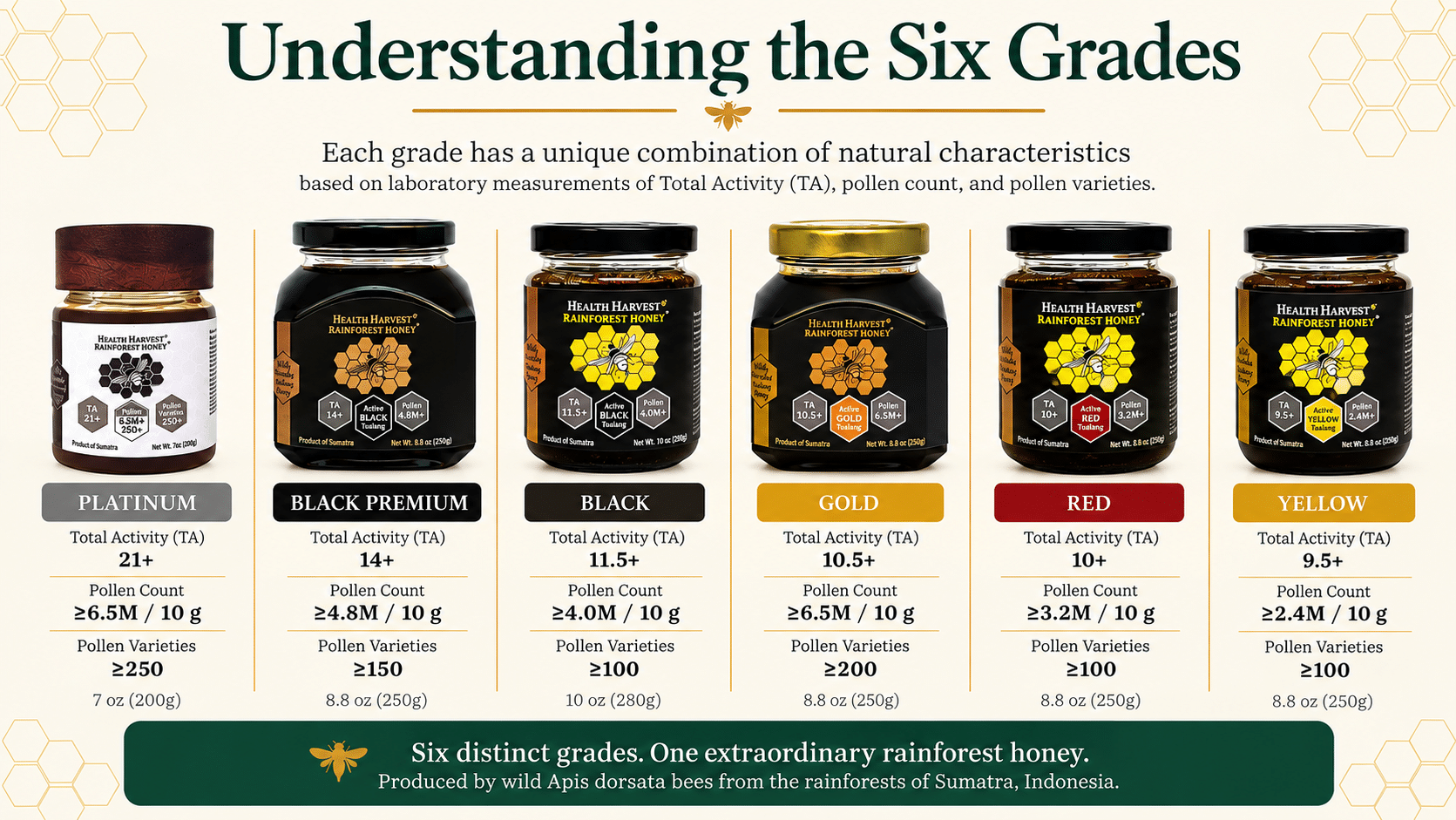
TA 21+ · 6.5 million+ pollen grains per 10 g · 250+ pollen varieties. Independently laboratory tested.
Buy directly from Bee-Licious Honey, an official U.S. distribution partner for Health Harvest.
The 200 g jar includes a free PDF of The Story Behind Tualang Honey. Download after payment. No printed book included.

Understanding Health Harvest Tualang Honey
Tualang honey is a wild, multifloral honey made by Apis dorsata, the giant Asian honeybee. The Tualang tree provides a nesting site, while the surrounding rainforest flowers supply nectar and pollen. Health Harvest sources its honey from Sumatra, Indonesia.
What do the measurements mean?
Health Harvest uses laboratory results to classify its six grades: Yellow, Red, Black, Black Premium, Gold, and Platinum.
- Total Activity (TA) measures antibacterial activity under laboratory conditions.
- Pollen count measures the number of pollen grains in 10 grams of honey.
- Pollen varieties describe the diversity of plant sources identified through pollen analysis.
These measurements describe different characteristics. A higher TA does not automatically mean a higher pollen count or greater botanical diversity.
Choosing your honey
Consider the measurements alongside flavor, jar size, and price. Nectar sources change between harvests, so color, flavor, and texture can vary naturally.
Compare the Health Harvest Tualang honey collection or explore our Tualang Honey Guide to learn more about the bees, harvesting, testing, and research.
Pollen count is reported as pollen grains per 10 grams of honey.
Why Can Tualang Honey Vary Between Harvests?
Tualang honey comes from wild Apis dorsata colonies rather than managed European honey bee hives. The bees forage across many flowering plants in the Sumatran rainforest, so the nectar sources available to them can change throughout the year.
Those natural differences are one reason laboratory testing is useful: rather than assuming that every harvest is identical, the measurements document characteristics of individual batches.
Learn More About Tualang Honey
Want to learn more about where Tualang honey comes from and what researchers have studied?


