Is Tualang Honey Good for Memory? Here’s What the Research Says
Last updated: Sept 2026
Tualang honey is one of the few specialty honeys that has been studied in human memory research.
In a randomized clinical trial involving 102 healthy postmenopausal women, participants who consumed 20 grams of Tualang honey daily for 16 weeks showed improvement in selected measures of immediate verbal learning and memory. Researchers reported that the improvement was comparable with changes observed in women receiving estrogen-plus-progestin therapy, although the overall pattern of results was not identical.
A second human study also found improvement in immediate learning and memory performance after eight weeks of Tualang honey supplementation.
These human findings, along with more than a decade of neurological research, have made Tualang honey an important subject in the growing scientific conversation about honey, memory, and brain health.
What did the human memory study find?
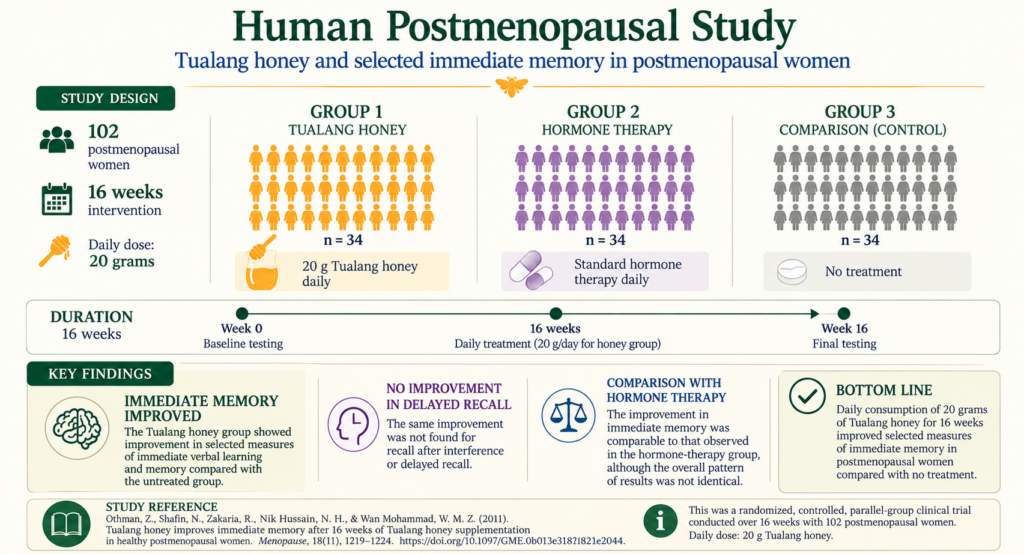
The best-known human study of Tualang honey and memory was published in the journal Menopause in 2011.
Researchers recruited 102 healthy postmenopausal women and randomly assigned them to three groups:
One group consumed 20 grams of Tualang honey daily.
One group received estrogen-plus-progestin therapy.
One group received no treatment and served as the comparison group.
Twenty grams of honey is approximately one tablespoon. The study continued for 16 weeks, with researchers evaluating verbal learning and memory before and after the intervention.
Women who consumed Tualang honey showed improvement in selected measures of immediate verbal learning and memory compared with the untreated group. The researchers reported that the improvement in immediate memory was comparable with that observed in the estrogen-plus-progestin group, although the overall pattern of results was not identical.
The same improvement was not found for recall after interference or delayed recall, making the findings specific to certain measures of immediate memory rather than every area of memory performance.
This research was especially important because it moved the study of Tualang honey beyond laboratory testing and animal models and into a randomized human clinical trial.
Read the original human memory study
Why were postmenopausal women studied?
During and after menopause, changes in estrogen levels can affect memory and other aspects of cognitive function. Researchers chose healthy postmenopausal women because they provided a meaningful population in which to investigate whether earlier observations about Tualang honey might also appear in human memory testing.
The inclusion of an estrogen-plus-progestin group gave researchers an additional comparison. Both the honey group and the hormone-therapy group showed improvement in immediate memory after 16 weeks.
The researchers did not conclude that honey and hormone therapy are medically interchangeable. Their finding was that the improvement measured in the Tualang honey group was comparable with the improvement observed in the hormone-therapy group on the immediate-memory test used in the study.
Download the Human Memory Research Summary
A second human study found improved learning performance
The 2011 postmenopausal study was not the only human research involving Tualang honey and cognition.
In 2020, researchers published a randomized controlled trial involving 80 patients with schizophrenia. Cognitive difficulties, including problems with verbal learning and memory, are common among people with schizophrenia and can continue even when other symptoms are being treated.
Participants in the Tualang honey group consumed 20 grams daily for eight weeks in addition to their regular care.
After eight weeks, the Tualang honey group showed improvement in total learning performance across measures of immediate memory. The researchers did not find significant improvement in long-term memory.
This study involved a very specific patient population, but it added another human finding to the growing research on Tualang honey, learning, and immediate memory.
Read the 2020 human cognitive study
Human research also found changes in oxidative stress
Researchers have also studied what might help explain the memory findings.
Oxidative stress occurs when reactive molecules build up faster than the body can manage them. Scientists study oxidative stress because it can affect cells throughout the body, including neurons and other cells involved in brain function.
In a related randomized study, 78 healthy postmenopausal women received either 20 grams of Tualang honey daily or estrogen-plus-progestin therapy for 16 weeks.
Women in the Tualang honey group showed increased activity in two antioxidant enzymes, glutathione peroxidase and catalase. They also had a significant decrease in 4-hydroxynonenal, a marker associated with oxidative stress.
The researchers reported that Tualang honey reduced blood oxidative-stress levels and activities in a manner comparable with the changes observed in the hormone-therapy group.
This study does not prove that the antioxidant changes caused the improvement in memory, but it offers researchers a possible connection to continue investigating.
Read the oxidative-stress study
How might Tualang honey support memory?
Researchers have not identified one individual compound responsible for the findings. Tualang honey is a complex natural food containing phenolic acids, flavonoids, enzymes, pollen-derived components, and other plant compounds gathered by bees across the rainforest.
Scientists have proposed several ways these compounds may work together.
Antioxidant activity
Phenolic compounds and flavonoids are frequently studied for their antioxidant activity. By helping the body manage oxidative stress, these compounds may help protect cells from damage.
Support for memory-related areas of the brain
Animal research has examined physical changes in the hippocampus and prefrontal cortex, two areas strongly involved in learning and memory. Some studies found better-preserved neurons or higher neuronal counts in animals receiving Tualang honey.
Effects on inflammation
Inflammation is another area of interest in neurological research. Laboratory and animal studies have examined how Tualang honey interacts with inflammatory pathways that may affect brain cells and cognitive function.
Naturally occurring plant compounds
Some flavonoids identified in honey are being studied for their possible interactions with cellular signaling, neurotrophic factors, and pathways related to neuronal survival. Tualang honey contains many compounds, so its activity may come from several components working together rather than one isolated ingredient.
Researchers are still working to understand which of these mechanisms matter most and how they relate to the results observed in people.
What animal research adds to the picture
Before Tualang honey was studied in human participants, much of the early neurological research was conducted in animals. Scientists have continued using animal models to investigate questions that cannot initially be studied in people.
Researchers have examined Tualang honey in connection with:
Learning and recognition memory
Age-related memory changes
Stress-related memory impairment
Oxidative stress in the brain
Inflammation and neuronal damage
Changes in the hippocampus and prefrontal cortex
Reduced oxygen or blood flow to the brain
Several studies found that animals receiving Tualang honey performed better on memory tasks than untreated animals. Researchers also observed differences in oxidative-stress markers and the condition or number of neurons within memory-related areas of the brain.
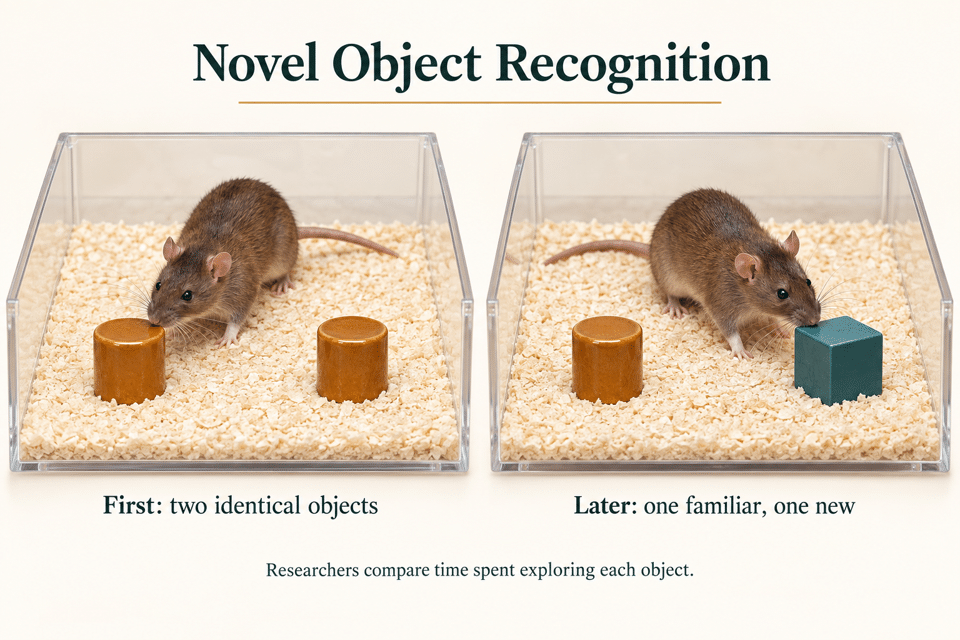
One method used in animal memory research is the Novel Object Recognition test. A rodent is first exposed to two identical objects. Later, one familiar object is replaced with a new object. Researchers compare how much time the animal spends exploring each object. Greater interest in the new object can indicate that the animal remembers the one it encountered earlier.
These experiments help scientists investigate how memory works and identify possible biological mechanisms. They also helped build the scientific foundation that eventually led to human Tualang honey studies.
More than a decade of neurological research
A 2021 scientific review examined 28 original papers published between 2011 and 2020 involving Tualang honey and the central nervous system.
The research covered memory and learning as well as stress, anxiety, mood, pain response, oxidative stress, inflammation, and neuroprotection. The reviewers found that antioxidant and anti-inflammatory activity appeared repeatedly across the research and could help explain some of the neurological findings.
The review also highlighted the human studies in postmenopausal women and patients with schizophrenia, along with the much larger collection of animal research.
Read Tualang Honey: A Decade of Neurological Research
What the latest systematic review found
In 2024, researchers published a systematic review bringing together more than two decades of Tualang honey research.
The review included human clinical trials, animal studies, and laboratory investigations across several areas of health. Within its section on neuroprotection, the authors identified the human findings involving immediate memory and learning as important parts of the evidence.
The reviewers also summarized studies in which Tualang honey was associated with improved memory performance, protection against oxidative stress, reduced neuronal damage, and changes in brain areas related to learning and memory.
By examining the studies together, the review showed how Tualang honey research has progressed from early laboratory analysis to animal experiments and human clinical trials.
Read the 2024 systematic review
Why Tualang honey has attracted so much research
Tualang honey is produced by the giant Asian honey bee, Apis dorsata. Unlike honeybees kept in managed boxes, Apis dorsata builds a single enormous exposed comb high in the branches of rainforest trees.
These bees forage across large areas containing many flowering plants, creating a complex multifloral honey shaped by the biodiversity of the surrounding rainforest.
Tualang honey has drawn scientific attention because of its:
Diverse phenolic compounds and flavonoids
Antioxidant activity
Wide range of pollen sources
Naturally occurring enzymes and plant compounds
Activity in laboratory antimicrobial testing
Results in neurological and cognitive research
Rather than being associated with only one plant, Tualang honey reflects the many botanical sources visited by the bees. Its exact composition can vary naturally with the forest, season, and harvest.
Health Harvest Tualang Honey from Sumatra
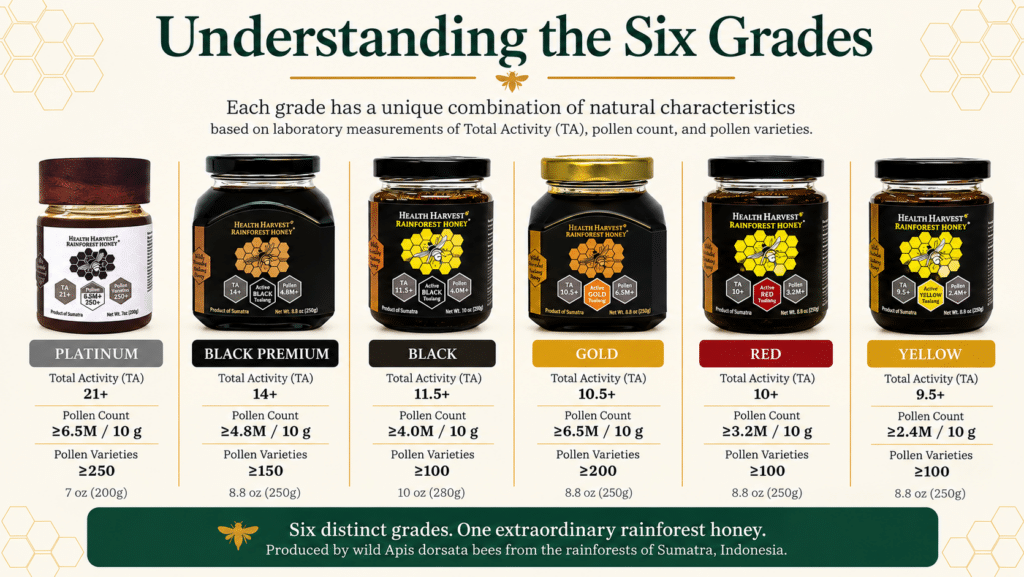
Health Harvest Tualang Honey is wild harvested from Apis dorsata colonies in the rainforests of Sumatra, Indonesia.
The honey matures naturally inside the bees’ enormous exposed combs before it is harvested using traditional methods. It is minimally processed without added heat or other ingredients and is filtered three times to remove natural debris from the comb while retaining the honey’s natural character.
Health Harvest has developed a six-grade system based on independent laboratory analysis. The grades are compared using three primary measurements:
Total Activity (TA)
Pollen density
Number of pollen varieties
The six grades are Platinum, Gold, Black Premium, Black, Red, and Yellow. The grades are not simply a best-to-lowest ranking. Each has a different combination of Total Activity, pollen count, and botanical diversity.
Bee-Licious Honey is an official U.S. distribution partner for Health Harvest, providing customers with access to authentic, laboratory-tested Tualang honey from Sumatra.
Explore Health Harvest Tualang Honey
What the research tells us so far
The human research on Tualang honey has already produced an encouraging finding: healthy postmenopausal women who consumed 20 grams daily for 16 weeks showed significant improvement in immediate memory.
A second human study also found improvement in immediate learning and memory performance after eight weeks. Related human research found changes in antioxidant enzymes and oxidative-stress markers after Tualang honey supplementation.
These human findings are supported by a much larger body of animal and laboratory research examining memory, learning, oxidative stress, inflammation, and changes in memory-related areas of the brain.
Tualang honey has not been established as a treatment for Alzheimer’s disease, dementia, or another neurological condition. However, the published research helps explain why scientists continue to study it and why people interested in memory, healthy aging, and the natural complexity of honey are paying attention.
Frequently asked questions
Is Tualang honey good for memory?
Human research has found improvement in immediate memory and learning performance following Tualang honey supplementation. The most frequently cited study involved 102 healthy postmenopausal women who consumed 20 grams daily for 16 weeks.
How much Tualang honey was used in the memory study?
Participants consumed 20 grams daily, which is approximately one tablespoon. This was the amount selected for the clinical research and should not be interpreted as an established medical dosage.
How long did the participants consume Tualang honey?
The healthy postmenopausal women consumed it for 16 weeks. Participants in the later schizophrenia study consumed Tualang honey for eight weeks.
Did Tualang honey improve long-term memory?
The strongest human findings involved immediate memory and learning. The studies did not find the same significant improvement in delayed or long-term recall.
Has Tualang honey been studied in people?
Yes. Tualang honey has been included in human clinical research involving memory, oxidative stress, cardiovascular measurements, bone markers, inflammation, wound care, and other subjects.
Does Tualang honey prevent dementia or Alzheimer’s disease?
Tualang honey has not been proven to prevent or treat dementia or Alzheimer’s disease. The memory findings are encouraging, but more human research is needed.
What makes Health Harvest Tualang Honey different?
Health Harvest Tualang Honey is wild harvested from Apis dorsata colonies in the rainforests of Sumatra. Each grade is independently laboratory tested and categorized using Total Activity (TA), pollen density, and pollen diversity
References
Othman Z, Shafin N, Zakaria R, Nik Hussain NH, Wan Mohammad WMZ. Improvement in immediate memory after 16 weeks of Tualang honey supplement in healthy postmenopausal women. Menopause. 2011;18(11):1219–1224. doi:10.1097/GME.0b013e31821e2044.
Shafin N, Othman Z, Zakaria R, Nik Hussain NH. Tualang honey supplementation reduces blood oxidative stress levels/activities in postmenopausal women. ISRN Oxidative Medicine. 2014;2014:364836. doi:10.1155/2014/364836.
Yahaya R, Zahary MN, Othman Z, et al. Tualang honey supplementation as cognitive enhancer in patients with schizophrenia. Heliyon. 2020;6(5):e03948. doi:10.1016/j.heliyon.2020.e03948.
Azman KF, Zakaria R, et al. Tualang Honey: A Decade of Neurological Research. Molecules. 2021;26(17).
Shamsol Azman ANS, Tan JJ, Abdullah MNH, et al. Medicinal activities of Tualang honey: a systematic review. BMC Complementary Medicine and Therapies. 2024;24:358. doi:10.1186/s12906-024-04664-2.
About the author
Jennifer Lytle is the co-founder of Bee-Licious Honey and an Oregon beekeeper who enjoys helping people understand the stories, origins, and research behind specialty honeys. She reviews published research on Tualang honey and turns complex scientific information into clear educational resources for consumers. Jennifer is also the author of the upcoming book, The Story Behind Tualang Honey.
This article is provided for educational purposes and is not medical advice. Tualang honey is not intended to diagnose, treat, cure, or prevent any disease. Speak with a qualified healthcare professional about concerning changes in memory or cognitive function.


